BONBON TÈ MAJIK
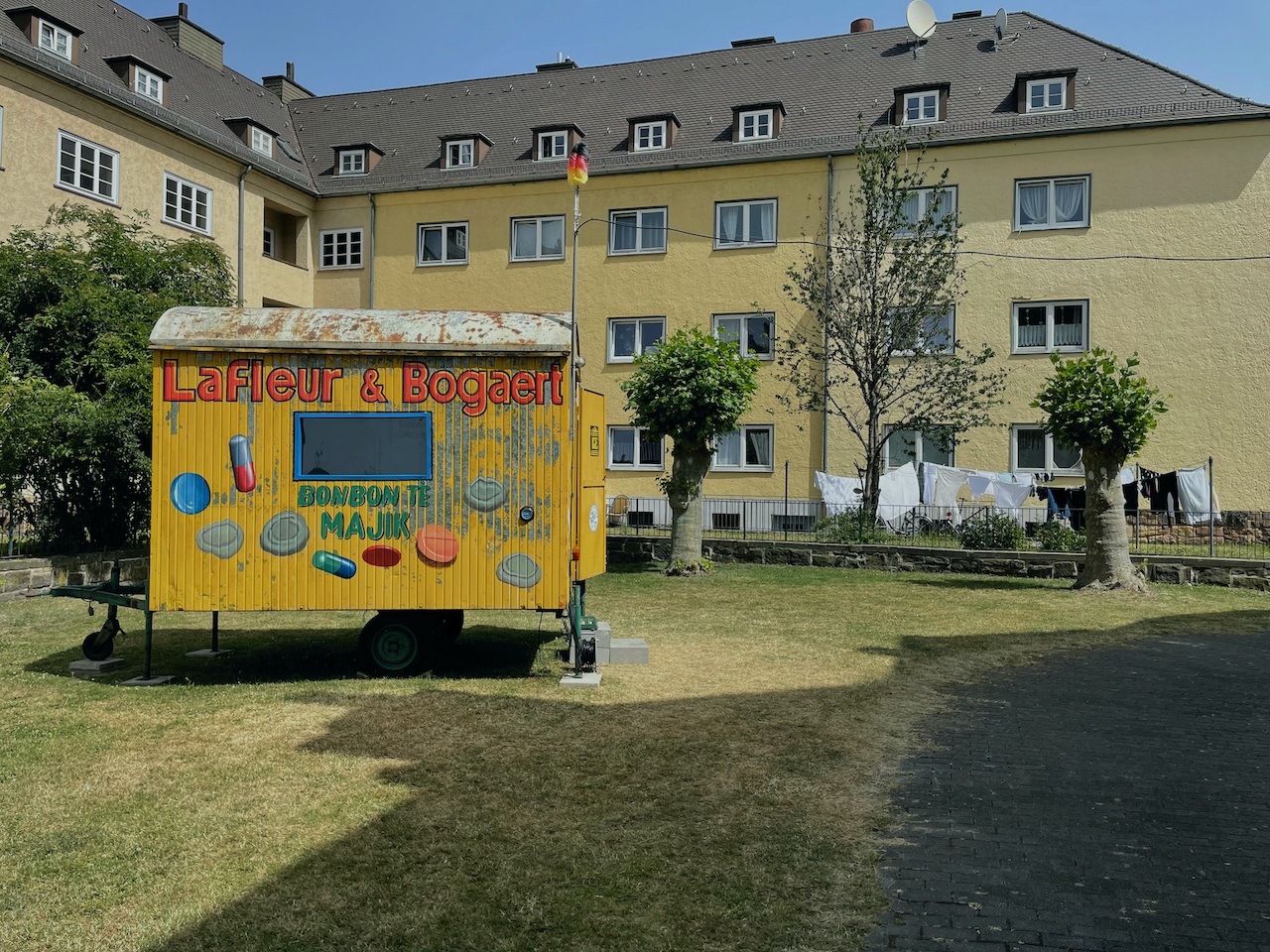


Bonbon Tè Majik (2022)
Installation view documenta fifteen in Kassel, Germany.
As part of Atis Rezistans’s participation in documenta fifteen, the duo Lafleur & Bogaert made Bonbon Tè Majik (Magical Mud Cakes) and offered them to the public.
Haitian mud cakes, typically prepared from a special type of mud mixed with salt and vegetable fat, are often described by Western commentators as an unequivocal sign of the country’s pervasive poverty, literally forcing people to eat dirt. Yet others argue that they are in fact a traditional nutritional supplement, favoured especially by pregnant women for their mineral values.
In fact, the practice of eating earth or soil-like substances, also called geophagia, is known in numerous regions around the world; it was first described by Hippocrates almost 2500 years ago and has been attributed religious properties in Christianity, Islam, Hinduism, and Vodou.
For documenta fifteen, Lafleur & Bogaert produced their mud cakes with soil from a clay pit near Kassel, questioning what gets lost in translation, but also how meanings and values shift (in cultural, religious, nutritional, and monetary terms) when local practices are dislocated. In this way, the work of this collective complicates the reading of a practice in terms of what is perceived as a response to a crisis vs what is valued or recognised as local knowledge and practice.
Julie Ren, Charlotte Matter, Rosa Sancarlo & Virginia Marano.
Published in Third Text: “Crisis and Collectives Shaping Art Events” in January 2024.

Bonbon Tè Majik (2022)
Performance baking and selling of mud cakes at documenta fifteen in Kassel, Germany.
 Bonbon Tè Majik (2023)
At the Rising Arts Festival in Melbourne, Australia.

Bonbon Tè Majik (2023)
At the Rising Arts Festival in Melbourne, Australia.

Bonbon Tè Majik (2024)
At the Verbeke Foundation in Stekene, Belgium.
 Bonbon Tè Majik (2026)
150 × 45 × 45 cm.
Approximately 100 Haitian mud cakes packaged in plastic bags and presented on a rotating merchandise rack. Displayed and sold outside a street-side shop on Avenue du Parc, directly opposite Picha Art Center in Lubumbashi, DR Congo.
Bonbon Tè Majik brings Haitian earth to Lubumbashi and Congolese earth to Haiti, setting two materials—and the histories they carry—into motion across the Atlantic. The project’s first iteration was at documenta fifteen in 2022, where the artists produced and distributed mud cakes using soil from a clay pit near Kassel.
Composed of clay, salt, and margarine, Haitian mud cakes are often reduced in Western media to depictions of extreme poverty. In Haiti, however, they are also understood in relation to mineral intake and to geophagy, the intentional consumption of earth or clay—a practice with long histories in cultures around the world.
For the 9th Biennale de Lubumbashi, curator Sorana Munsya invited Lafleur & Bogaert to develop the project in relation to the biennial’s theme, Manger la Terre. Here, earth is not approached only as a resource to be extracted, or as a victim of extraction, but as a carrier of nourishment, memory, myth, knowledge, and displacement.
Mud cakes purchased in Port-au-Prince travel to Lubumbashi, where they are presented in handcrafted bags. Their journey symbolically retraces the Atlantic in reverse: Haitian earth returns to the African continent from which so many ancestors of the Haitian people were violently taken through slavery.
At the same time, medicinal clay bought at Lubumbashi’s central market—locally known as Pemba—travels to Port-au-Prince. There, Michel Lafleur responds to the material creating a parallel exchange whose results enter the Biennale.
Excerpt from the exhibition text by Annick M’Kele, journalist, author, and editorial coordinator of the 9th Biennale de Lubumbashi.